The Qatar monetary system has undergone a remarkable transformation over centuries, evolving from ancient Islamic gold and silver coins to one of the most stable and valuable currencies in the Middle East today. The history of currency in Qatar reflects broader economic, political, religious, and commercial developments that shaped the Arabian Gulf region over more than 1,400 years.
From the era of the early Islamic caliphates to the establishment of the modern Qatari Riyal, Qatar’s monetary history mirrors the country’s transition from a small pearling and trading society into one of the world’s wealthiest energy-driven economies.
Today, the Qatari Riyal stands among the strongest and most stable currencies globally, supported by Qatar’s massive natural gas wealth, strong sovereign reserves, and tightly managed monetary policies overseen by Qatar Central Bank.
Understanding the evolution of the Qatar monetary system provides valuable insight into the country’s economic development, trade history, and regional influence throughout the centuries.
Origins of the Qatar Monetary System
The origins of the Qatar monetary system date back to the early Islamic era during the rule of the Uthman Caliphate between 644 and 656 Common Era.
During this period, Islamic economic systems became increasingly organized, and the use of standardized currency expanded across the Muslim world. The dirham and dinar emerged as the primary monetary units used for trade, taxation, and commercial transactions.
The Dirham and Dinar
The two dominant Islamic coins were:
- Dirham — made primarily of silver
- Dinar — made primarily of gold
These coins became the foundation of economic activity across large parts of the Islamic world for nearly 1,500 years.
The term “dirham” remains historically significant because it continues to survive in modern Gulf currencies today, including subdivisions of the Qatari Riyal and the UAE Dirham.
Standardization Under Caliph Umar
The Islamic monetary system became more standardized during the era of Caliph Umar ibn Al-Khattab.
Historical records indicate that:
- Islamic dirhams were standardized at approximately 3 grams of pure silver
- Coin designs became more uniform
- Trade regulations strengthened
This standardization helped Islamic currencies gain trust across major trade routes stretching from the Middle East to parts of Europe and Asia.
Islamic Coins and Global Trade Influence
The early Islamic monetary system was highly influential internationally.
Historical discoveries show that Arab and Islamic coins circulated far beyond the Arabian Peninsula. Islamic dirhams have been found in:
- Russia
- Baltic regions
- Central Asia
- Eastern Europe
This widespread circulation demonstrates how important Islamic trade networks became during medieval times.
Trade Networks and Gulf Commerce
The Arabian Gulf region, including the territory that later became Qatar, played an important role in maritime trade routes connecting:
- India
- Persia
- East Africa
- Mesopotamia
- Arabia
Pearls, spices, textiles, dates, and precious metals were commonly exchanged through these trade systems.
Currency stability became essential for sustaining commercial trust between merchants from different regions and cultures.
Transition From Coins to Paper Currency
For centuries, metal coins dominated trade across the Middle East.
However, the global monetary system gradually changed as paper money became more common.
Chinese Origins of Paper Currency
Historical evidence shows that China pioneered the use of paper money centuries earlier than much of the world.
Paper currency later spread gradually into other regions through trade and imperial influence.
Ottoman Introduction of Banknotes
The Ottoman Empire played a major role in introducing paper money into the Islamic world during the 19th century.
According to historical records, the Ottoman Caliphate issued some of its first paper notes in 1842 during the reign associated with the Gaykhatu period influence.
This represented a major shift in monetary systems across Muslim territories.
Religious Concerns Over Paper Money
Initially, paper currency faced resistance among some Islamic scholars and merchants due to concerns about compliance with Sharia principles.
Gold and silver had long been viewed as inherently valuable assets, while paper notes represented symbolic value backed by governments.
Over time, however, paper money became widely accepted due to:
- Growing international trade
- Expanding economies
- Banking system development
- Practicality in large-scale commerce
Early Currency Use in Qatar
Before the establishment of the modern Qatari Riyal, multiple foreign currencies circulated within Qatar.
Because Qatar historically relied heavily on trade, pearling, and regional commerce, various currencies were accepted depending on trading partners and political relationships.
Pearl Trade Economy
Before oil discovery, Qatar’s economy depended largely on:
- Pearling
- Fishing
- Maritime trade
Pearls from the Gulf region were highly valuable internationally, particularly in India and Europe.
Currency circulation during this period often involved:
- Indian rupees
- Ottoman coins
- Gulf trade currencies
- Gold and silver coins
British Influence and Gulf Currency Systems
As British political influence expanded across the Gulf region during the late 19th and early 20th centuries, Indian currency became increasingly common in Gulf trade economies.
The Indian Rupee circulated widely in Qatar and neighboring Gulf states for many years because of strong trade links between British India and the Gulf.
Establishment of the Modern Qatari Riyal
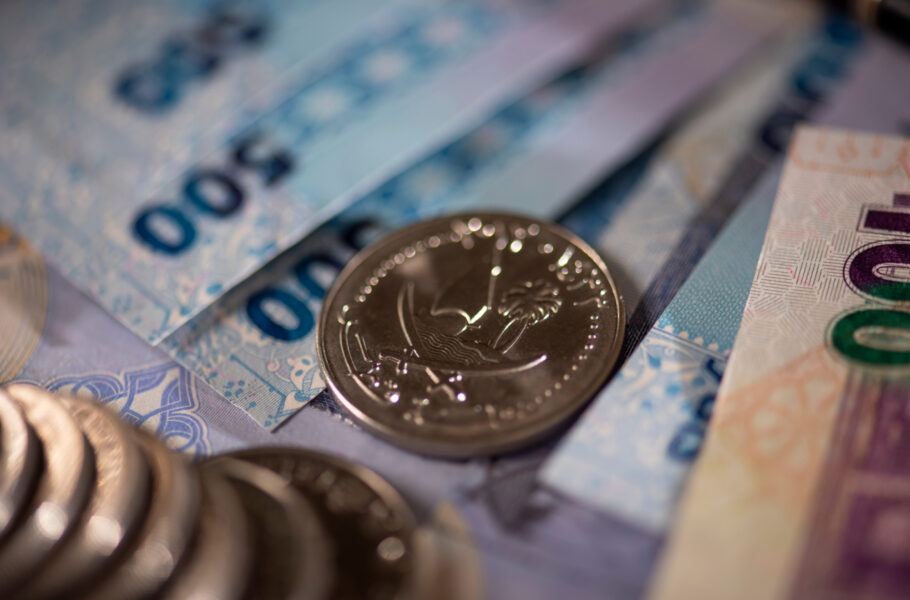
The modern Qatar monetary system officially entered a new phase with the creation of the Qatari Riyal.
The Qatari Riyal was officially introduced on May 19, 1973 after formal government approval.
This marked a major milestone in Qatar’s economic sovereignty following independence from Britain in 1971.
Structure of the Qatari Riyal
The Qatari Riyal is abbreviated as:
- QR
- QAR
The currency is divided into 100 dirhams.
Qatari Banknotes
The original banknote denominations included:
- 1 Riyal
- 5 Riyals
- 10 Riyals
- 50 Riyals
- 100 Riyals
- 500 Riyals
Qatari Coins
Coin denominations included:
- 1 dirham
- 5 dirhams
- 10 dirhams
- 25 dirhams
- 50 dirhams
The use of “dirham” as the fractional currency reflects the deep historical continuity of Islamic monetary terminology.
Role of Qatar Central Bank
The Qatar Central Bank plays the central role in managing the country’s monetary stability.
Its responsibilities include:
- Currency issuance
- Banking regulation
- Inflation management
- Monetary policy
- Financial supervision
The institution also oversees anti-counterfeiting measures and ensures confidence in the Qatari financial system.
Pegging the Riyal to the US Dollar
One of the most important developments in the modern Qatar monetary system was the decision to peg the Riyal to the US Dollar.
Since July 2001:
- 1 US Dollar = 3.64 Qatari Riyals
This fixed exchange rate system provides monetary stability and predictability for:
- Investors
- International businesses
- Energy markets
- Importers and exporters
Why the Dollar Peg Matters
Qatar’s economy is heavily linked to:
- Oil exports
- LNG exports
- International trade
Most global energy transactions are conducted in US Dollars, making the peg strategically important for economic stability.
The fixed exchange rate also helps reduce currency volatility.
Oil, Gas and Currency Strength
The strength of the Qatari Riyal is closely connected to Qatar’s energy wealth.
The discovery of oil and later the massive expansion of liquefied natural gas production transformed Qatar into one of the richest countries in the world per capita.
North Field Gas Expansion
The development of the North Field gas reserves became particularly important.
Qatar eventually became:
- The world’s leading LNG exporter
- A major sovereign wealth investor
- One of the Gulf’s strongest economies
These developments strengthened confidence in the Qatar monetary system globally.
Security Features and Modern Currency Design
Modern Qatari banknotes contain advanced security features designed to prevent counterfeiting.
These features include:
- Watermarks
- Metallic strips
- Holographic elements
- Advanced printing technology
Cultural Symbols on Qatari Currency
Qatari banknotes also feature important national symbols reflecting:
- Heritage
- Architecture
- Economic development
- Maritime history
- Islamic identity
The designs highlight Qatar’s transformation from a traditional Gulf society into a modern global economy.
Currency Collecting and Historical Notes
Qatar’s historical banknotes and coins have become increasingly interesting to collectors and numismatists.
Rare older Qatari notes are often valued for:
- Historical significance
- Design rarity
- Printing errors
- Limited circulation
Collectors of Gulf currencies often seek:
- Early Riyal issues
- Historical dirham coins
- Transitional Gulf currencies
Qatar’s Monetary System in the Modern Economy
Today, the Qatar monetary system ranks among the most stable in the Middle East.
The country benefits from:
- Strong foreign reserves
- Sovereign wealth investments
- Stable banking systems
- Low inflation management
- Strong LNG export revenues
The financial sector continues expanding as Qatar diversifies its economy beyond hydrocarbons.
Digital Banking and Future Developments
Like many modern economies, Qatar is increasingly embracing:
- Digital banking
- Electronic payments
- Fintech development
- Mobile wallets
- Cashless transactions
Qatar’s banking sector continues modernizing rapidly while maintaining strong monetary oversight.
The future of the Qatar monetary system may eventually include:
- Central bank digital currencies
- Expanded fintech regulation
- Blockchain-based financial systems
Conclusion
The evolution of the Qatar monetary system tells the story of a nation shaped by trade, religion, maritime commerce, oil wealth, and economic modernization. From the silver dirhams of the early Islamic caliphates to the modern Qatari Riyal pegged to the US Dollar, Qatar’s currency history reflects centuries of regional and global economic transformation.
Today, the Qatari Riyal stands as a symbol of economic stability, national sovereignty, and financial strength supported by one of the world’s most resource-rich economies.
As Qatar continues expanding its global financial influence, the country’s monetary system remains central to its long-term economic vision and international position.
Disclaimer
Historical interpretations and monetary timelines may vary across academic and governmental sources. Readers are encouraged to consult official historical and financial references for additional details regarding Qatar’s monetary history.
Read Also: Alpha Dhabi Holding PJSC (ALPHADHABI) | Abu Dhabi Securities Exchange