During the global COVID-19 pandemic, Qatar introduced several travel and residency procedures to manage international arrivals, public health safety, and border control measures. One of the most important temporary systems implemented during this period was the Exceptional Entry Permit Qatar process, commonly known as the Exceptional Entry Permit (EEP).
The Exceptional Entry Permit was created to help Qatar residents stranded outside the country return legally despite international travel restrictions and temporary border limitations. The permit became especially important for expatriates, residents holding Qatar IDs (QIDs), employees, and family members who needed official approval to re-enter the country during periods of restricted travel.
At the same time, Qatar also introduced additional health-related travel systems such as Ehteraz pre-registration and quarantine procedures. These digital systems formed part of Qatar’s broader pandemic management strategy, helping authorities monitor arrivals, vaccination status, testing compliance, and public health safety requirements.
Although many of the emergency travel restrictions introduced during the pandemic were later eased or removed, the Exceptional Entry Permit remains an important part of Qatar’s recent immigration and travel history. Many residents still search for information about the EEP process, especially when reviewing past travel procedures, immigration policies, or documentation requirements related to COVID-era travel.
Understanding how the Exceptional Entry Permit Qatar system worked provides useful insight into how Qatar managed resident returns, digital travel authorization, and border operations during one of the most challenging periods in modern international travel.
What Was the Exceptional Entry Permit Qatar?
The Exceptional Entry Permit (EEP) was a temporary authorization system introduced during the COVID-19 pandemic.
Main Purpose of the Permit
The permit allowed Qatar residents stranded abroad to re-enter the country legally during travel restrictions.
Who Could Apply?
The service was available for:
- Qatar residents
- QID holders
- Sponsored family members
- Employees
- Dependents
Government Management
The permit system was managed through:
- Ministry of Interior (MOI)
- Government digital portals
- Employer sponsorship systems
Why the Exceptional Entry Permit Was Introduced
The permit emerged during strict international travel controls caused by the coronavirus pandemic.
Managing Border Restrictions
Countries worldwide implemented temporary border limitations during COVID-19.
Controlled Resident Return
Qatar needed a system to regulate returning residents safely.
Public Health Protection
The permit process helped authorities monitor arrivals and quarantine procedures.
Coordination With Health Systems
Travel approvals were linked to:
- COVID testing
- Quarantine rules
- Vaccination verification
- Health monitoring systems
Supporting Residents Abroad
Many expatriates were temporarily unable to return to Qatar because of travel disruptions.
Connection Between EEP and Ehteraz Registration
The EEP process later became connected with Ehteraz pre-registration requirements.
Ehteraz Travel Registration
Qatar required many travelers to pre-register through the Ehteraz platform before travel.
Mandatory for Visitors
Visitors traveling to Qatar were required to complete registration.
Optional for Citizens and Residents
At certain stages, registration became optional for some residents and citizens.
Travel Authorization Integration
The permit and health registration systems worked together during pandemic travel management.
Who Needed an Exceptional Entry Permit?
The EEP mainly targeted Qatar residents who were outside the country during restrictions.
Qatar ID Holders Abroad
Residents with valid QIDs were among the primary users.
Sponsored Family Members
Family members under sponsorship could also receive permits.
Employees and Workers
Employers could apply on behalf of workers and employees.
Residents Traveling Out of Qatar
Residents leaving Qatar during certain periods automatically received return permits upon departure.
Automatic EEP Issuance for Departing Residents
At one stage during the pandemic, residents leaving Qatar received automatic return authorization.
Automatic Permit Generation
Residents departing Qatar could automatically receive an Exceptional Entry Permit linked to their travel records.
Simplified Return Procedures
This helped reduce manual approval requirements for returning residents.
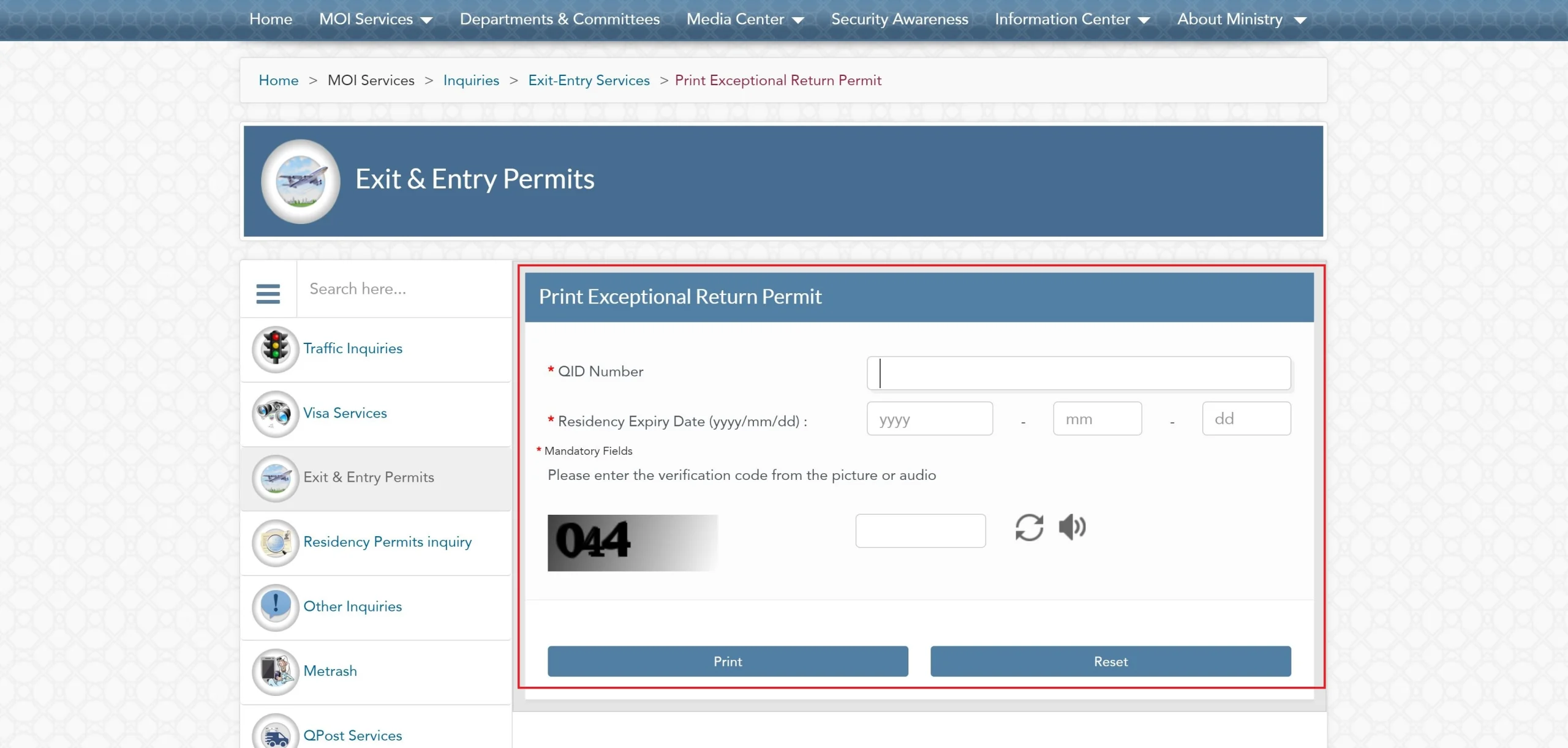
How to Print Exceptional Entry Permit Qatar
The Ministry of Interior allowed residents to print their permits online.
Step 1: Visit the MOI Website
Users first needed to access the Ministry of Interior website.
Official Government Portal
The process was completed through MOI online services.
Step 2: Select “Inquiries”
Users then selected:
- Inquiries
from the MOI services menu.
Step 3: Open “Exit & Entry Permits”
The next section required selecting:
- Exit & Entry Permits
Step 4: Select “Print Exceptional Return Permit”
Users then clicked:
- Print Exceptional Return Permit
Step 5: Enter Required Information
Applicants needed to provide:
- QID number
- Residency expiry date
Verification Process
The system verified permit eligibility and travel authorization.
Step 6: Print the Permit
Once approved, users could print or save the permit electronically.
Information Required for the EEP Process
The permit system relied heavily on official residency data.
Qatar ID Number
Applicants needed valid QID information.
Residency Expiry Date
The system required active residency records.
Sponsor and Residency Verification
Authorities verified sponsorship and legal residency status.
Why Digital Travel Systems Became Important
The EEP highlighted the importance of digital government systems during emergencies.
Faster Processing
Online systems reduced physical office visits during the pandemic.
Improved Border Coordination
Authorities could better manage arrivals and travel approvals.
Public Health Monitoring
Digital systems supported testing and quarantine enforcement.
Reduced Administrative Delays
Electronic permits simplified approval procedures.
Qatar’s Broader COVID-19 Travel Policies
The EEP was part of wider pandemic management measures.
Quarantine Procedures
Travelers often faced quarantine requirements depending on origin country and vaccination status.
Testing Requirements
COVID testing became mandatory for many arrivals.
Vaccination Verification
Vaccination records later became integrated into travel approval systems.
Travel Classification Systems
Countries were categorized according to health risk levels during certain stages.
Role of the Ministry of Interior During the Pandemic
The Ministry of Interior played a central role in managing immigration and travel procedures.
Immigration Coordination
MOI coordinated with:
- Health authorities
- Airlines
- Border control agencies
Digital Service Expansion
The pandemic accelerated Qatar’s adoption of digital government services.
Public Information Services
Government platforms provided updated travel instructions and procedures.
How Qatar’s Digital Government Systems Expanded
The pandemic accelerated modernization of online services across Qatar.
Online Government Portals
More services became available digitally.
Mobile Applications
Apps such as Ehteraz and Metrash became essential tools.
Reduced In-Person Transactions
Digital systems minimized physical crowding and administrative delays.
Lessons From the Exceptional Entry Permit System
The EEP system demonstrated how countries adapted immigration systems during global crises.
Flexibility During Emergencies
Governments needed rapid digital solutions during unpredictable situations.
Importance of Digital Infrastructure
Online systems became essential for national operations.
Integration Between Agencies
Health, immigration, and transportation systems increasingly worked together.
Global Travel Transformation
The pandemic permanently changed many international travel procedures.
Frequently Asked Questions
What was the Exceptional Entry Permit Qatar?
It was a temporary travel authorization system allowing Qatar residents stranded abroad to return during COVID-19 travel restrictions.
Who needed an Exceptional Entry Permit?
Residents, QID holders, sponsored family members, and workers returning to Qatar during pandemic restrictions.
How could residents print the EEP?
Residents could print the permit through the MOI website under Exit & Entry Permits services.
What information was required to print the EEP?
Users needed:
- QID number
- Residency expiry date
Was Ehteraz registration connected to travel approval?
Yes. Ehteraz pre-registration became part of Qatar’s pandemic travel management procedures.
Conclusion
The Exceptional Entry Permit Qatar system played a major role during one of the most challenging periods in modern international travel. Introduced during the COVID-19 pandemic, the permit helped Qatar manage border restrictions, facilitate resident returns, support public health protection, and maintain immigration control during rapidly changing global conditions.
By integrating digital government services, online permit systems, and health-related travel procedures, Qatar demonstrated how modern technology could support emergency travel management efficiently. Although many pandemic-related restrictions have since been removed, the Exceptional Entry Permit remains an important example of how governments adapted immigration and border systems during a global crisis while continuing to support residents, workers, and families abroad.